A crater lake that most La Fortuna itineraries skip entirely
Laguna del Hule doesn’t show up on the postcards. It isn’t ringed by hot spring resorts, there’s no zipline over it, and nobody promises you a volcano view from its shore. What it is: a small, forest-fringed crater lake in the highlands between San Carlos and the Central Valley, quiet enough that a visit here often means having the trail to yourself. If your image of a Costa Rican lake is something vast and blue with boats crossing it, put that image aside — that’s a different lake, in a different part of this region, and the two get confused more often than you’d expect.
This page covers what Laguna del Hule actually is, how to get there from La Fortuna, what a visit involves, and — because the mix-up is common enough to address directly — exactly how it differs from Lake Arenal, the reservoir most visitors have already heard of before they arrive.
Don’t confuse it with Lake Arenal
This is the single most important clarification on this page, so it goes first, not buried in an FAQ.
Laguna del Hule is a natural crater lake: small, a few hectares of dark water sitting inside what was once a volcanic vent, surrounded by forest, with no dam, no marina, and no lakeside hotel strip. Lake Arenal is an artificial reservoir of roughly 85 sq km, created when the Arenal Dam was closed in 1979, flooding the valley and the old villages that became Nuevo Arenal.
One is a geological curiosity you walk around in under two hours. The other is the largest lake in the country, crossed by boat as part of the jeep-boat-jeep route to Monteverde, lined with lodges, and visible from the road for a good stretch of the drive around Tilarán.
They also sit in different parts of the region this site covers. Lake Arenal is in the la-fortuna-arenal and lake-arenal areas, close to the volcano and the main tourist corridor. Laguna del Hule is further south and east, in the quieter northern lowlands zone near Ciudad Quesada, Zarcero, and Juan Castro Blanco National Park — a working agricultural highland, not a resort strip. If a search result or a driver mentions “the crater lake,” ask whether they mean this one or something else; the confusion goes both ways.
Where it actually sits
Laguna del Hule lies in the hilly country north of Ciudad Quesada, near the edge of Juan Castro Blanco National Park’s forest system, in an area that also holds the Laguna del Hule name for both the lake and, loosely, the surrounding forest patch. Access is usually through a private or community-managed entry point rather than a formal park gate — a detail worth knowing before you show up expecting a ranger station with a gift shop.
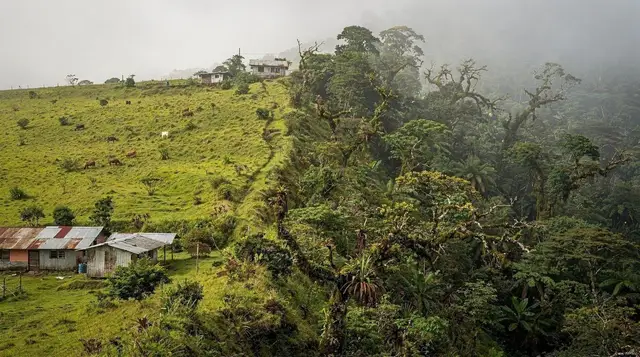
The region it belongs to on this site, northern-lowlands, also covers Caño Negro, the Río Frío, Sarapiquí and Puerto Viejo de Sarapiquí, Ciudad Quesada itself, Zarcero, and Juan Castro Blanco. It’s a working landscape of dairy farms, vegetable plots, and patches of remaining cloud and premontane forest — a genuinely different texture from the volcano-and-hot-springs circuit around La Fortuna town.
Getting there from La Fortuna
There’s no bus route to the lake and no organized shuttle. Almost everyone arrives by rental car, private driver, or as a stop on a custom day tour built around the Ciudad Quesada / Zarcero corridor.
| From | Route | Approximate time |
|---|---|---|
| La Fortuna town centre | Via Ciudad Quesada, then minor highland roads | About 1h15 |
| Ciudad Quesada | North on local roads toward Juan Castro Blanco | 20-30 minutes |
| Zarcero | Backtrack north, partly unpaved | 25-40 minutes |
| San José (via this route) | Continue south through Zarcero toward the Central Valley | 1h30-2h onward |
The roads narrow and lose pavement in stretches once you’re off the main Ciudad Quesada highway, and — as everywhere in this part of the country — expect single-lane bridges where the vehicle facing a CEDA EL PASO sign yields. A standard sedan can usually manage it in dry season; in the green season (May-November), a higher-clearance vehicle removes some of the guesswork on softer sections.
If you’re travelling without a rental car, see our notes on getting around La Fortuna without a car — Laguna del Hule is one of the harder stops to reach independently, and a private driver or a custom tour based out of Ciudad Quesada is the practical workaround.
What a visit looks like
There’s no visitor center with staff on hand, no cafe, and no gift shop. What there is: a trailhead, a walking loop of 45 minutes to 1.5 hours depending on how far the current path runs around the crater rim, and a viewpoint or two over the water. The forest here sits at a cooler, mistier elevation than La Fortuna town, closer in feel to the approach to Monteverde than to the lowland heat around the volcano.
Bring the same basics you’d pack for any forest trail in this region: closed shoes (the terciopelo, or fer-de-lance, is present throughout Costa Rica’s forested lowlands and highlands alike), rain gear even on a dry-looking morning, and insect repellent. There’s no swimming here — the water is a still crater lake, not a beach, and there’s no lifeguard or facility for it.
Birdwatchers tend to get the most out of a stop here. The lake’s edge and surrounding wetland pull in waterbirds and forest species without the crowds of a better-known reserve, which is part of the appeal for anyone who has already spent a few days doing the busier stops around La Fortuna and Monteverde.
Fees and access
| Detail | What to expect |
|---|---|
| Entry fee | Roughly USD 5-15, paid at the access point, not a national park booth |
| Opening hours | Generally daylight hours only; no night access |
| Facilities | Minimal — a trail and a viewpoint, not a full visitor center |
| Guide requirement | Not mandatory, but the access roads are unmarked |
| Best time of day | Morning, before highland cloud and afternoon rain move in |
Because there’s no centralized booking system like the one used for Arenal, the Río Celeste trail, or Poás, access arrangements here can shift year to year depending on who is managing the land. If you’re planning a special trip specifically for this lake, it’s worth confirming current access with a local operator before you drive an hour and a half on the strength of an old blog post.
Realistic expectations
This is worth being blunt about: Laguna del Hule is not a headline destination, and it shouldn’t be sold as one. It’s a small, calm forest lake that rewards a short stop with an easy trail and a bit of solitude — not a full-day excursion, not a swimming spot, and not comparable in scale or drama to Lake Arenal, the Río Celeste’s turquoise water, or the volcano-adjacent hot springs closer to La Fortuna town. If you go in expecting a minor, pleasant detour, that’s exactly what you’ll get.
It also isn’t part of any fixed GetYourGuide or Viator circuit — there’s no packaged “Laguna del Hule tour” the way there is for the Mistico Hanging Bridges or a hot springs day pass. Most visitors reach it as a private arrangement or a custom stop with a driver who knows the area, which is part of why it stays quiet.
What to pair it with
Because Laguna del Hule sits on the corridor between La Fortuna and the Central Valley, it makes the most sense as one stop in a longer drive rather than a dedicated outing. A few practical pairings:
- Ciudad Quesada gardens and waterfalls. The town itself, and stops like the Quesada Hobbit Village gardens and waterfalls tour, sit only 20-30 minutes from the lake and make a natural half-day combination.
- Zarcero’s topiary gardens. A short backtrack north brings you to Zarcero’s well-known trimmed hedges, a pleasant stretch-your-legs stop before continuing toward San José.
- A soak back in La Fortuna. After a longer highland loop, many travelers head back toward town and finish the day at the hot springs — the Baldi Hot Springs admission ticket is a straightforward option if you want a full-service pool complex rather than the free river option.
- Extending into Sarapiquí. If your route continues toward the lowlands rather than back to La Fortuna, the Sarapiquí rainforest night walk with a wildlife guide is a good way to use the wildlife-watching momentum from the lake trail.
- A highland alternative. For travelers who’d rather trade the crater lake for a saddle, the Naranjo Highlands horseback ride with picnic covers similar high-elevation countryside further along toward the Central Valley.
For planning the wider loop, see our guides on renting a car for La Fortuna, how many days in La Fortuna you actually need before a highland detour makes sense, and the day trip to Caño Negro if wetland birding is the priority rather than a crater lake. If Poás and the Central Valley are also on your route, our Poás Volcano day trip guide covers that leg, and the arriving via Liberia itinerary is useful if you’re weighing which airport and which direction to loop your trip.
Should you make the detour?
If you’re a first-timer with three or four days and a checklist of the volcano, the hot springs, and the hanging bridges, Laguna del Hule probably isn’t the best use of your time — see first time in La Fortuna for what to prioritize instead. If you’ve got a rental car, you’re already routing through Ciudad Quesada or Zarcero, and you’d like an hour of quiet forest without another entrance fee the size of a zipline park, it’s a reasonable, low-key addition. Go for the trail and the birds, not for a lake to rival Arenal — it was never built to be that.
Frequently asked questions about visiting Laguna del Hule
Is Laguna del Hule the same as Lake Arenal?
No. Laguna del Hule is a small volcanic crater lake covering a few hectares, formed naturally inside a collapsed cone. Lake Arenal is an artificial reservoir of about 85 sq km created by a dam in 1979. They’re in different parts of the region, and mixing them up leads to very wrong expectations.
How do I get to Laguna del Hule from La Fortuna?
The most direct route runs through Ciudad Quesada, then onto minor roads toward the Juan Castro Blanco area, about 1h15 in total. There’s no scheduled shuttle or bus service to the lake itself, so it’s a self-drive or private-guide destination.
Do I need a guide to visit?
Not strictly, but the approach roads are unmarked and mostly gravel in places, and there’s no visitor center staff on site to help if you get turned around. A local driver-guide or a private day tour from Ciudad Quesada removes that guesswork.
Is there an entrance fee?
Access typically runs through private land or a community-managed trail, with a modest entry fee in the range of USD 5 to 15 depending on who currently manages the access point. There’s no fixed national park booth like at Arenal or Tenorio.
How long does the hike around the lake take?
The main loop and viewpoint trail takes most visitors 45 minutes to 1.5 hours at an easy pace, depending on how far around the crater rim the current trail extends and how much time is spent birdwatching.
What will I actually see there?
A still, dark-green crater lake ringed by cloud forest and secondary growth, some open water for waterbirds, and a quiet trail with little foot traffic compared to Arenal or Monteverde. There’s no swimming area, no zipline, and no hot spring on site.
Can I combine Laguna del Hule with other stops?
Yes, and most visitors do. It sits close to Ciudad Quesada and on the general route toward Zarcero and the Central Valley, so it pairs naturally with a Quesada garden and waterfall stop, a Zarcero topiary detour, or a longer loop toward Poás and San José.
Is Laguna del Hule inside Juan Castro Blanco National Park?
It sits near the park’s boundary in the same highland forest system, though access to the lake itself is usually through a separate, privately managed entry point rather than the park’s main gate.